Free, about thirty seconds, no signup
Test your site on a phone. Then test one of ours.
Google gives every website a public speed score out of 100. You can look yours up right now without giving anyone your email address. Most owners have never seen theirs.
Run it yourself
We would rather you saw your own number than took our word for anything. The test below is Google’s, not ours. It is free, it works on any website, and nobody has to know you ran it.
Test yours first, while you have no idea what it will say. Then test ours and put the two side by side.
Step two: run the same test on ours
Test www.scwebdesigns.com (opens in new tab)Both links run Google’s own test, on a mid-range phone over a slow 4G connection. That is the setup Google uses because it is closer to how most people actually browse than an office desktop on fibre.
Same test, same day, same phone
Here is what the gap looks like.
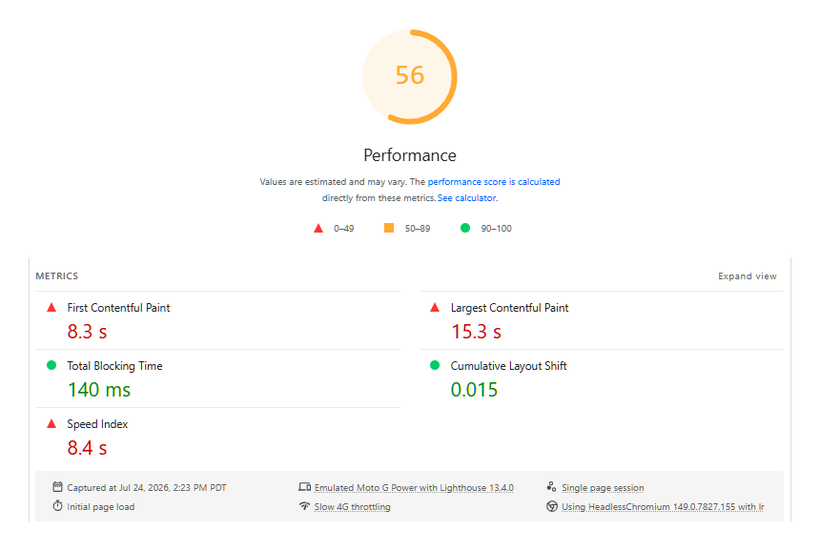
Two real websites, both tested on 24 July 2026 on a mid-range Android phone over a slow 4G connection. One is a local service business. The other is this site. We have cropped the preview image off the first one because the point is the number, not the business.
A local clinic website
Built on a common template platform. Scored 56 out of 100.
This website
Hand-built, no page builder, no plugins. Scored 96 out of 100.
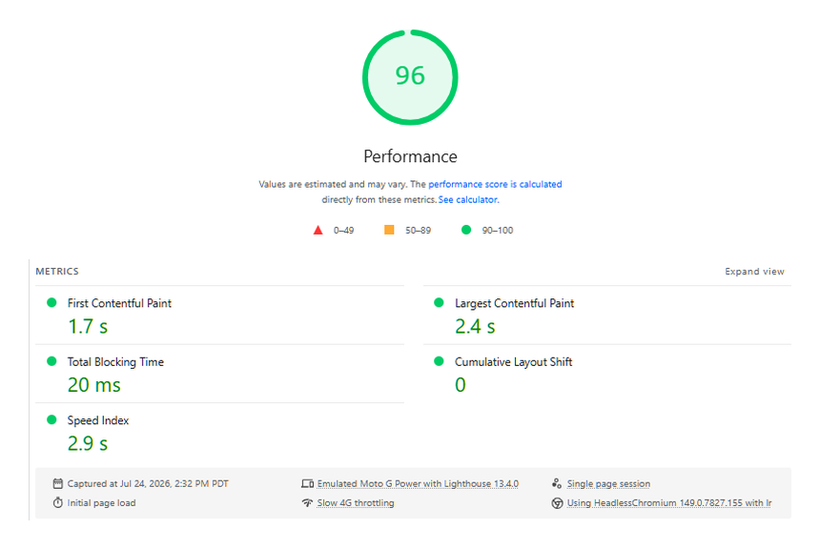
Scores move a few points between runs, and a heavier site is not automatically a worse business. What does not move is the gap. Thirteen seconds is thirteen seconds.
What those numbers mean in plain English
Ignore the score for a second. The three measurements underneath it are the ones your customers actually feel.
- Largest Contentful Paint
- How long until the main thing on screen has actually loaded.
- Clinic site15.3 secondsThis site2.4 seconds
- First Contentful Paint
- How long the visitor stares at a blank screen before anything appears.
- Clinic site8.3 secondsThis site1.7 seconds
- Speed Index
- How quickly the page fills in and becomes useful.
- Clinic site8.4 secondsThis site2.9 seconds
Someone tapping your listing from a phone on a patchy signal does not know your page is loading. They know they are looking at nothing. Then they go back and tap the next result, which is your competitor.
You never see it happen. There is no missed call, no bounced email, nothing in the inbox to tell you it went wrong. That is what makes a slow site expensive: it costs you customers quietly.
Why the difference is that large
Most small business sites are built on a page builder sitting on top of a theme sitting on top of a plugin stack. Every layer adds code the visitor has to download before they see anything. A photo uploaded straight off a phone can be four megabytes on its own.
We build pages as plain static files, resize every image, and load no third-party scripts unless a page genuinely needs one. There is no clever trick to it. There is just far less to download.
That is also why speed is not a service we sell separately. Every site we build starts fast, because of how it is built rather than what we bolt on afterwards.
Send us what you got
Tell us your score and your web address. You will get a straight answer on what is slowing it down, whether it is worth fixing, and what it would cost, within one business day.
Sometimes the answer is that your site is fine and you should spend the money elsewhere. We will tell you that too.
Would rather talk it through? Book a 20 minute call (opens in new tab). Bring your web address and it will already have been looked at before we speak.
No newsletter, no drip sequence, no reselling your details. One reply from a person.
Speed is one of six
Fast is not the same as working.
A quick site can still fail to get found, fail to look credible, or fail to tell anyone what to do next. The scorecard runs 40 checks across all six, in about ten minutes.